Wind Chill Calculator
This calculator estimates the temperature felt by the body as a result of wind speed and actual air temperature. The calculator is based on the U.S. National Weather Service formula and works for air temperatures between -50°F and 50°F.
What is Wind Chill?
In winter, the temperature felt by the body is typically lower than the actual air temperature. This is because the wind strips away the thin layer of warm air above your skin. A surface, such as the skin on a person's body, loses heat through conduction, convection, and radiation. Wind chill temperature is mostly a result of convection. The faster the wind speed, the faster your body loses heat and the colder you feel. The result of wind chill is to increase the rate at which heat loss occurs.
How to Calculate Wind Chill
This calculator uses the formula developed by the National Weather Service in the United States, which was implemented to provide a more accurate measure of how cold it feels to humans.
Wind Chill (°F) = 35.74 + 0.6215T - 35.75(V0.16) + 0.4275T(V0.16)
Where T is the actual air temperature in Fahrenheit, and V is the wind speed in mph.
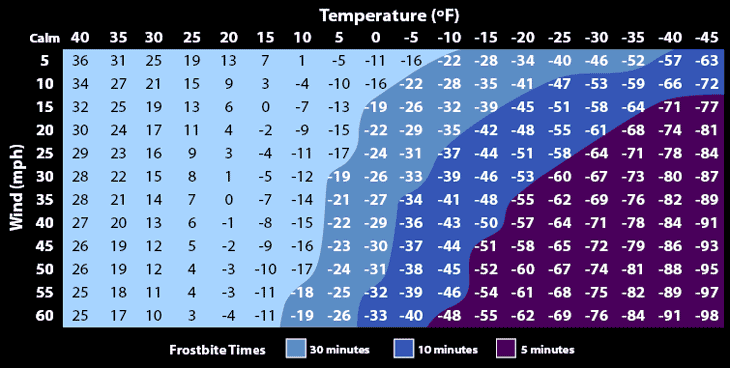
Frostbite and Hypothermia Risks
Frostbite can occur when skin or other tissue is exposed to low temperatures. It is a serious condition that can lead to permanent damage. Hypothermia occurs when the body dissipates more heat than it absorbs, leading to a dangerous reduction in core body temperature.
Frostbite Symptoms by Degree:
- First-degree: Superficial damage, numbness, and possible swelling.
- Second-degree: Blisters form and the skin surface hardens. Possible permanent cold sensitivity.
- Third-degree: Tissue below the skin freezes, causing bluish discoloration.
- Fourth-degree: Tendon, bone, and muscle are affected. Skin becomes hard and colorless.
How to Dress for the Cold
- 15 to 32°F (-10 to 0°C): Dress warmly with a hat, gloves, and scarf.
- -15 to 15°F (-25 to -10°C): Risk of hypothermia. Dress in layers: a wicking base layer, an insulating middle layer (like fleece), and a wind-resistant outer layer.
- -50 to -15°F (-45 to -25°C): Risk of frostbite on exposed skin. Cover all skin, particularly the face and hands. Add more insulating layers.
- Below -50°F (-45°C): Outdoor conditions are hazardous. Exposed skin can freeze in minutes. Limit time outside entirely.